Quick answer
What are the 24 solar terms in 2027?
The 24 solar terms (二十四节气) divide the sun’s yearly path into 24 equal steps of 15 degrees. In 2027 they run from Minor Cold on 5 January to Winter Solstice on 22 December. The most important for BaZi is Li Chun (Start of Spring) on 4 February 2027 at 09:46 Malaysia time, when the Fire Goat year begins. Each of the 12 “jie” terms also starts a new BaZi month.
Key takeaways
- The 24 solar terms follow the sun, not the moon, so their dates stay almost the same every year in the Western calendar.
- Twelve of them (the “jie” terms) start the BaZi months. Li Chun on 4 February 2027 starts both the Tiger month and the Ding Wei year.
- The solar terms drive the month pillar in BaZi, the Day Officers in the almanac and the change of annual Feng Shui stars.
- If you were born within a day of a solar term, check the exact time, because your month pillar, and sometimes your year, depends on it.
Most people in Malaysia know the Chinese calendar through Chinese New Year and the lunar dates of festivals. But BaZi, Feng Shui and traditional date selection are built on a different timetable: the 24 solar terms. They mark the sun’s position through the year and quietly decide your month pillar, the start of the zodiac year and the Day Officers printed in every almanac. At BaZi Pillar we work with the solar terms every day, and this guide lists all of them for 2027 with what they mean in practice.
You can see the solar term for any date in our free Chinese calendar.
What are the 24 solar terms?
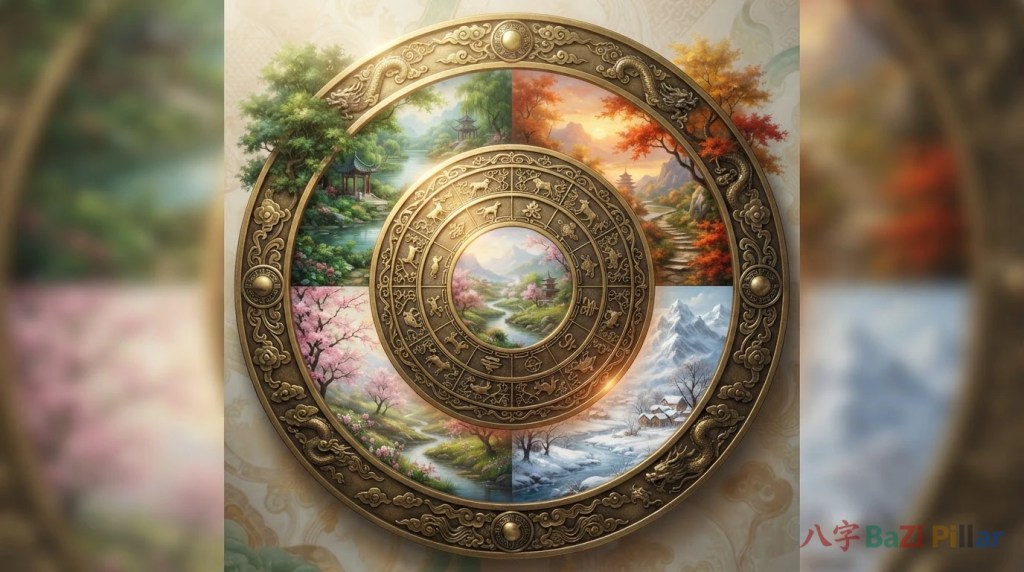
The solar terms (节气) divide the ecliptic, the sun’s apparent path, into 24 sections of 15 degrees each. A new term begins every 15 or so days. They were created in ancient China to guide farming, and their names describe the seasons of northern China: Start of Spring, Rain Water, Grain in Ear and so on.
The terms come in two types that alternate:
- Jie (节), the sectional terms: twelve terms that start each BaZi month. Li Chun, Jing Zhe, Qing Ming and the others.
- Qi (中气), the middle terms: twelve terms that mark the middle of each month, including the equinoxes and solstices.
Because the system follows the sun, the Western dates are very stable. Li Chun is almost always on 3, 4 or 5 February.
The 24 solar terms of 2027 (Malaysia time)
The table below lists all 24 terms in 2027. Dates are in Malaysia time (UTC+8), which is the same clock time as China, so they match Chinese almanacs. The terms marked “starts” begin a new BaZi month, shown with its month pillar.
| Solar term | Chinese | Date 2027 | BaZi month |
|---|---|---|---|
| Minor Cold | 小寒 | 5 January, 22:09 | Starts Xin Chou (Ox) month of the 2026 Horse year |
| Major Cold | 大寒 | 20 January | Middle of Ox month |
| Start of Spring (Li Chun) | 立春 | 4 February, 09:46 | Starts Ren Yin (Tiger) month; Ding Wei year begins |
| Rain Water | 雨水 | 19 February | Middle of Tiger month |
| Awakening of Insects | 惊蛰 | 6 March | Starts Gui Mao (Rabbit) month |
| Spring Equinox | 春分 | 21 March | Middle of Rabbit month |
| Clear and Bright (Qing Ming) | 清明 | 5 April | Starts Jia Chen (Dragon) month |
| Grain Rain | 谷雨 | 20 April | Middle of Dragon month |
| Start of Summer | 立夏 | 6 May | Starts Yi Si (Snake) month |
| Grain Buds | 小满 | 21 May | Middle of Snake month |
| Grain in Ear | 芒种 | 6 June | Starts Bing Wu (Horse) month |
| Summer Solstice | 夏至 | 21 June | Middle of Horse month |
| Minor Heat | 小暑 | 7 July | Starts Ding Wei (Goat) month |
| Major Heat | 大暑 | 23 July | Middle of Goat month |
| Start of Autumn | 立秋 | 8 August | Starts Wu Shen (Monkey) month |
| End of Heat | 处暑 | 23 August | Middle of Monkey month |
| White Dew | 白露 | 8 September | Starts Ji You (Rooster) month |
| Autumn Equinox | 秋分 | 23 September | Middle of Rooster month |
| Cold Dew | 寒露 | 8 October | Starts Geng Xu (Dog) month |
| Frost’s Descent | 霜降 | 23 October | Middle of Dog month |
| Start of Winter | 立冬 | 7 November | Starts Xin Hai (Pig) month |
| Minor Snow | 小雪 | 22 November | Middle of Pig month |
| Major Snow | 大雪 | 7 December | Starts Ren Zi (Rat) month |
| Winter Solstice (Dong Zhi) | 冬至 | 22 December, 10:42 | Middle of Rat month |
The exact minute of each term matters for births and precise date selection. If you need the time for a specific term, check our calendar for that date or ask a practitioner.
Why do the solar terms matter for BaZi?
In BaZi, the year and month pillars change at the solar terms, not at the lunar new moon:
- The year changes at Li Chun. A baby born on 1 February 2027 is still in the Bing Wu Horse year, even though it is close to Chinese New Year. A baby born on 5 February 2027 is a Ding Wei Goat.
- Each month changes at its jie term. A baby born on 5 March 2027 has a Tiger month pillar; a baby born on 7 March has a Rabbit month pillar.
The month branch is the most important factor in judging the strength of the day master, so a one-day difference near a solar term can change the reading. Our guide on how to read a BaZi chart explains why. If you were born close to a term and are unsure of your birth time, see BaZi without a birth time.
How do solar terms affect Feng Shui and date selection?
- Annual flying stars change at Li Chun. The 2027 chart, with the Five Yellow in the North and the wealth star 8 in the South-east, takes effect from 4 February 2027. See our Feng Shui 2027 flying star chart.
- Tai Sui moves to the Goat (South-west) at Li Chun as well. Read more in our Year of the Fire Goat 2027 forecast.
- Day Officers restart their cycle at each jie term, which is why the same date has a different officer each year. See our guide to the 12 Day Officers.
- Monthly flying stars also change at each jie term, which matters for timing renovations.
Practitioners usually avoid starting big events on the day of a solar term itself, because the energy is in transition. The days just after are considered more settled.
Which solar terms are celebrated in Malaysia?
Two solar terms are also festivals for many Malaysian Chinese families:
- Qing Ming (清明), 5 April 2027: the tomb-sweeping festival. Families visit ancestral graves and columbaria in the days around this term.
- Dong Zhi (冬至), 22 December 2027: the winter solstice festival, celebrated with tang yuan (glutinous rice balls). Traditionally it is said that eating tang yuan makes you a year older.
Li Chun itself is marked by some families with prayers, and many people refresh their Feng Shui arrangements on or after that day.
How should I use the solar terms in daily life?
- Check birth dates near term changes for accurate BaZi charts.
- Plan renovations around the change of monthly and annual stars, especially if work involves the North in 2027.
- Pick dates within the right month. A wedding date good in the Rabbit month may not be good in the Dragon month, even a few days apart. See our auspicious wedding dates 2027.
- Refresh Feng Shui cures at Li Chun so they match the new year’s stars.
If you need a precise date or a chart for a birth near a solar term, ask about our BaZi and Feng Shui consulting.
How did the solar terms begin?
The solar terms grew out of farming on the Yellow River plain more than two thousand years ago. Early observers measured the noon shadow of a gnomon, a simple upright pole, to find the solstices and equinoxes, then divided the year between them.
By the Han dynasty, the Huainanzi listed all 24 terms with the names still used today. Each term covers about 15 days of the sun’s path, so the system follows the solar year, not the moon. That is why the terms fall on nearly the same Gregorian dates every year.
In 2016, UNESCO inscribed the 24 solar terms on its list of the Intangible Cultural Heritage of Humanity. For BaZi, their importance is practical: the start of each month pillar is set by a solar term, and the year pillar changes at Li Chun, not at Chinese New Year. You can see each term marked in our Chinese calendar.
Frequently asked questions
Why does BaZi start the year at Li Chun instead of Chinese New Year?
BaZi follows the solar calendar, which tracks the seasons. Li Chun marks the start of spring. Chinese New Year follows the moon and can fall up to two weeks before or after Li Chun.
Are the solar term dates the same every year?
Almost. They usually move by only a day between years, because the Western calendar is also solar. The exact time changes each year.
Do solar terms apply in Malaysia even though we have no winter?
Yes. The names describe the seasons of China, but the terms are astronomical points on the sun’s path, so they apply everywhere. BaZi and Feng Shui use them regardless of local weather.
What happens if I was born on the day of a solar term?
Your month pillar depends on whether you were born before or after the exact time of the term. Check your birth time carefully, adjusted for your place of birth.