Quick answer
How do you read a BaZi chart?
Start with the day master, the top character of the day pillar, which represents you. Then judge whether it is strong or weak from the month of birth and the other characters, find your useful elements, read the Ten Gods around the day master, and finally check the 10-year luck pillars and the current year to see when each part of the chart is activated.
Key takeaways
- A BaZi chart has four pillars (year, month, day, hour), each with a heavenly stem on top and an earthly branch below: eight characters in total.
- The day master is you. Everything else in the chart is read in relation to it.
- The month branch shows the season of birth and is the biggest factor in deciding whether the day master is strong or weak.
- Useful elements, the Ten Gods and the luck pillars turn a static chart into practical advice about career, money, relationships and timing.
A BaZi chart looks intimidating at first: eight Chinese characters, five elements and a lot of new words. But reading it follows a clear order, and once you know the steps you can understand the main story of any chart. At BaZi Pillar we read every chart in the same sequence, from the day master outwards, and this guide walks you through that process in plain English.
Before you start, generate your chart in our free BaZi calculator. You will need your date of birth, the time of birth if you know it, and the place of birth so the true solar time can be used.
Step 1: What are the four pillars and eight characters?
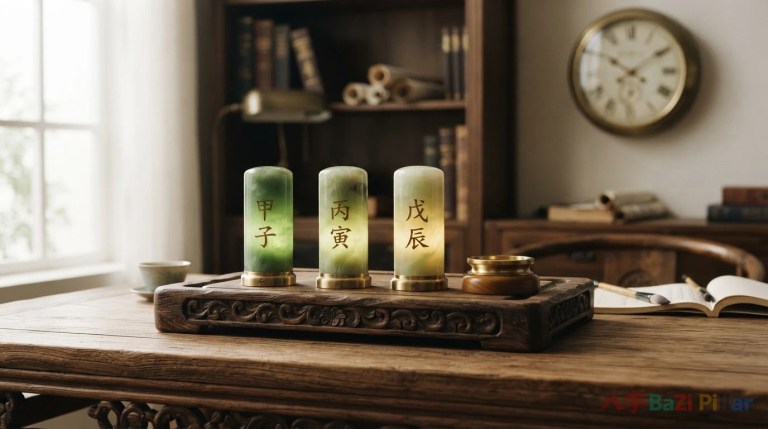
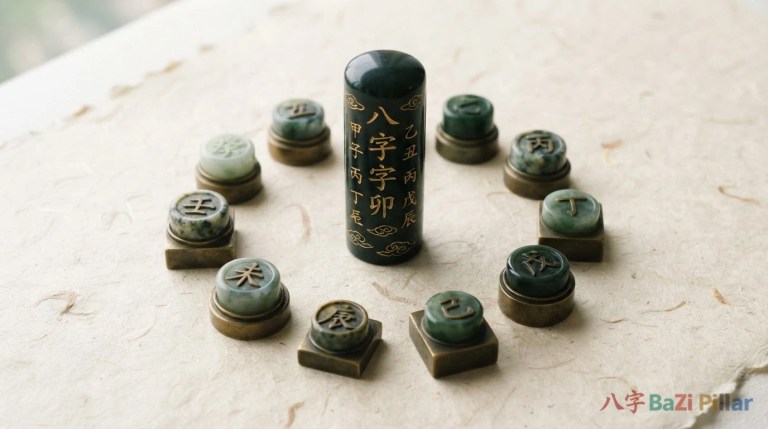
BaZi (八字) means “eight characters”. Your birth year, month, day and hour each become a pillar, and each pillar has two characters:
- a heavenly stem on top (one of ten: Jia, Yi, Bing, Ding, Wu, Ji, Geng, Xin, Ren, Gui), and
- an earthly branch below (one of twelve: the zodiac animals Rat to Pig).
| Pillar | Represents | Life stage |
|---|---|---|
| Year | Ancestors, family background, social circle | Childhood (about 0 to 16) |
| Month | Parents, siblings, career environment | Youth (about 17 to 32) |
| Day | You (stem) and your spouse (branch) | Adulthood (about 33 to 48) |
| Hour | Children, ideas, later life | Later life (49 onwards) |
BaZi uses the solar calendar, not the lunar one. The year changes at Li Chun around 4 February, and each month starts at a solar term. This is why someone born in late January belongs to the previous zodiac year. Our free Chinese calendar shows the solar terms for every date.
Step 2: How do I find my day master?
The day master (日主) is the heavenly stem of your day pillar. It represents you: your personality, your needs and how you respond to the world. There are ten day masters, a yang and a yin version of each element. For example, Jia is a tall tree, Bing is the sun and Gui is rain.
Everything else in the chart is read in relation to the day master. So the first question is always “what is this person’s day master, and how does it feel in this chart?” Our guide to the day master meaning describes all ten in detail.
Step 3: Is the day master strong or weak?
The strength of the day master decides almost everything that follows. To judge it, look at three things:
- The month branch (season). A day master born in its own season is strong. Wood is strong in spring (Tiger and Rabbit months), Fire in summer, Metal in autumn and Water in winter. Earth is strongest in the last month of each season.
- Support from other characters. Characters of the same element (companions) and the element that produces the day master (resource) make it stronger.
- Drains and controls. Characters that the day master produces (output), controls (wealth) or is controlled by (officer) make it weaker.
A quick count of elements helps, but the season counts most. A Jia Wood day master born in a Rabbit month with Water around it is clearly strong. The same Jia born in a Rooster month surrounded by Metal and Fire is weak.
Step 4: What are my useful and unfavourable elements?
Once you know the strength, you can find the useful elements (用神), the elements that bring the chart into balance:
- A strong day master benefits from elements that drain or control it: output, wealth and officer.
- A weak day master benefits from elements that support it: resource and companions.
Useful elements are the most practical part of a reading. They point to suitable industries, colours, directions and even good years. Our guide to useful elements in BaZi explains this step in more depth, with examples for each element.
Step 5: How do I read the Ten Gods?
Each character in the chart relates to the day master in one of ten ways, called the Ten Gods (十神). They translate elements into life themes:
- Companion and Rob Wealth: friends, siblings, competitors, self-confidence.
- Eating God and Hurting Officer: creativity, talent, expression, children for women.
- Direct and Indirect Wealth: money, business, father, wife for men.
- Direct Officer and Seven Killings: career, status, discipline, husband for women.
- Direct and Indirect Resource: learning, support, mother, property.
Notice which gods are strong, which are missing and which sit next to the day master. A chart full of Wealth with a weak day master, for example, often describes someone who sees many opportunities but feels stretched. Our article on the Ten Gods in BaZi explains each god in plain language.
Step 6: What do the branches and their interactions show?
The four branches interact with each other through combinations, clashes, punishments and harms. Pay special attention to the day branch, which is your spouse palace. A clash on it suggests movement in relationships, while a combination suggests a strong bond. Read more in our guide to the spouse palace in BaZi.
Each branch also contains hidden stems, which add depth. For example, the Dragon branch contains Wu Earth, Yi Wood and Gui Water. These hidden stems often explain traits that are not visible in the top row.
Step 7: How do luck pillars and years change the reading?
A natal chart shows potential. Luck pillars (大运) show timing. Each luck pillar lasts ten years and brings a new stem and branch that interact with your chart. When a luck pillar brings your useful element, life tends to flow. When it brings an unfavourable element, you may need to work harder in that decade.
On top of the luck pillar sits the year pillar of each calendar year. 2027 is Ding Wei, the Fire Goat year, so every chart meets Ding Fire and Goat Earth in 2027. Our guide to BaZi luck pillars explained shows how to calculate and read them.
A short worked example
Imagine a chart with a Bing Fire day master born in a Rat month (winter). Fire is weak in winter. If the chart also has Ren and Gui Water, the Fire is under heavy control, so the day master is weak.
- Useful elements: Wood (resource, which feeds Fire) and Fire (companions).
- Ten Gods: the strong Water is the Officer and Seven Killings, suggesting a demanding career or strict environment.
- Advice: fields linked to Wood and Fire, such as education, media or design; warm colours; facing east or south when possible.
- Timing: a luck pillar of Jia or Yi Wood, or Bing or Ding Fire, is likely to be a strong decade.
This is a simplified example, but it shows how each step builds on the one before.
What are common mistakes when reading a BaZi chart?
- Judging only by the zodiac animal. The year branch is one character out of eight.
- Counting elements without weighing the season. One strong month branch can outweigh three weak characters.
- Calling elements good or bad in general. An element is only useful or unfavourable for a specific day master.
- Ignoring time of birth. The hour pillar matters. If you do not know it, see our guide on reading BaZi without a birth time.
When you want a complete reading of your chart, including career, relationships and your next luck pillar, ask about our BaZi and Feng Shui consulting.
Frequently asked questions
What is the most important part of a BaZi chart?
The day master and its strength. Every other part of the chart, including the Ten Gods and useful elements, is read in relation to the day master.
Can I read my own BaZi chart?
Yes, you can learn the basics and understand the main themes. Judging strength and timing accurately takes practice, so many people combine their own study with a professional reading.
Why does BaZi use Li Chun instead of Chinese New Year?
BaZi is based on the solar calendar and the 24 solar terms. The year begins at Li Chun, the start of spring, around 4 February, which can be a few days before or after Chinese New Year.
How long does a luck pillar last?
Ten years. The age at which your first luck pillar starts depends on your birth date and gender, and is shown in your chart.