Quick answer
What should I check for Feng Shui before buying a house?
Check ten things: the surroundings and what the house faces, the road pattern, the shape of the land or unit, the main door, light and ventilation, the kitchen and toilet positions, the bedrooms, the staircase, how the facing suits your Kua number, and the property’s history. Problems with surroundings, roads and shape are hardest to fix, so weigh them most.
Key takeaways
- Outside factors (surroundings, roads, land shape) are the hardest and most expensive to fix, so check them first.
- Inside factors (door condition, kitchen, toilets, beds, stairs) can often be improved with layout changes or renovation.
- A home does not need to match everyone’s Kua perfectly. Make sure the main bedroom and a desk can face good directions.
- Bring a compass, visit at different times of day, and ask about the property’s history before you commit.
Buying a home is one of the biggest financial decisions most Malaysians make, and for many families Feng Shui is part of that decision. A good property supports health, harmony and career for years. A property with serious problems can feel draining no matter how nice the renovation is. At BaZi Pillar we often do pre-purchase checks for clients, and most of the warning signs can be spotted by anyone who knows what to look for.
This checklist covers ten points in order of importance, from the things you cannot change to the things you can. It applies to condominiums, apartments, terrace houses, semi-detached houses and bungalows. Before your viewing, find your Kua number with our free Kua number calculator so you know which directions suit you.
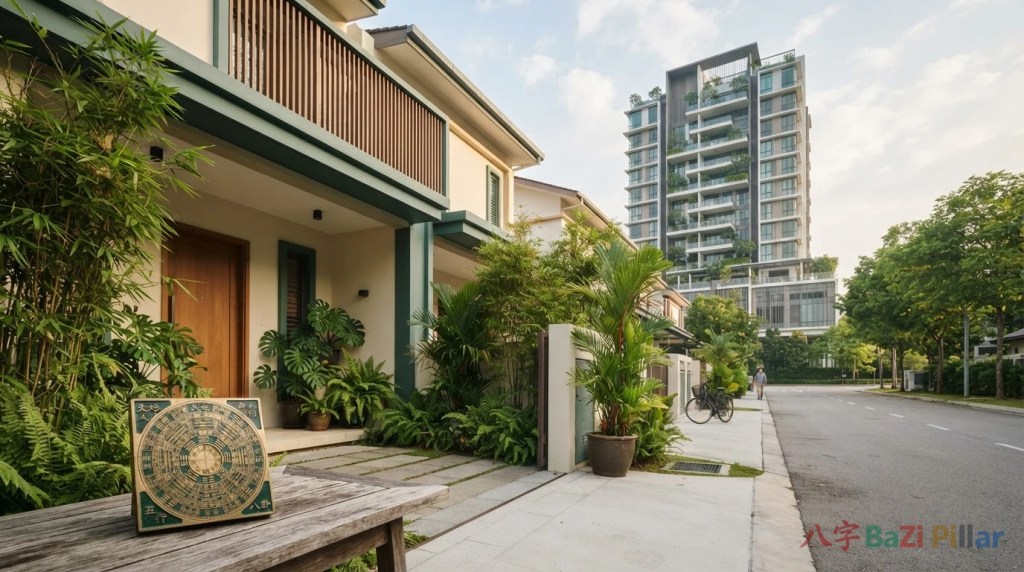
Point 1: What does the property face and what is behind it?
Classical Feng Shui looks for a supporting back and an open front. A hill, taller building or solid row of houses behind gives stability. An open space, park or wide road in front gives room for qi to gather.
Be careful if the main door or main windows directly face:
- A highway flyover, a large drain or a fast, noisy road very close by.
- A cemetery, a hospital entrance, a police station or a large substation and power pylons.
- The sharp corner of another building pointing at your unit.
- A temple or place of worship directly in front, which many traditions see as too strong for a residence.
These are not automatic deal breakers, but they are the hardest things to fix.
Point 2: How do the roads flow around the house?
Roads carry qi like rivers. In a taman, look for:
- T-junction (路冲): a road running straight at the house. This is one of the most common red flags for terrace and corner houses.
- Curved roads: a road that curves around the house like an embracing arm is good; a road whose outer curve points at the house is a “reverse bow” and less favourable.
- Dead ends: the last house of a dead-end road can feel stagnant if qi cannot circulate.
- Corner lots: popular for their extra land, but check that no road points directly at the door.
For condos, look at the internal corridor too. A long straight corridor ending at your door works like a small road hitting the house.
Point 3: Is the land or unit a regular shape?
Square and rectangular shapes are best because every sector of the home is complete. Watch for:
- Missing corners: L-shaped units or houses where one sector is cut away. In Eight Mansions Feng Shui each sector links to a family member, so a large missing corner can weaken that area.
- Triangular or irregular lots: harder to arrange and often have sharp angles inside.
- Very narrow, deep terrace houses: common in older areas. Make sure light reaches the middle of the house.
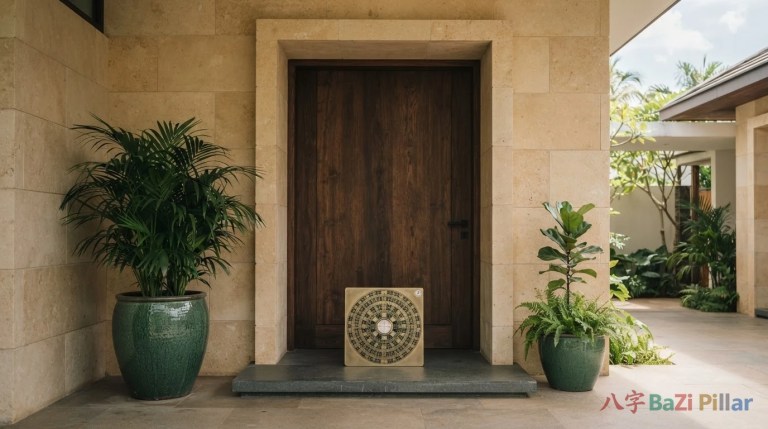
Point 4: Is the main door healthy?
The main door is the mouth of qi. Check that it is not facing a staircase going down, a lift, or a mirror-like glass wall, and that it is not in a straight line with the back door. The area just inside should be open and bright. Our full guide to main door Feng Shui explains each problem and its fix.
Point 5: Does the home get good light and air?
Qi follows light and fresh air. Visit in the morning and late afternoon. In Malaysia, strong west sun in the afternoon can make rooms hot and harsh, which both Feng Shui and comfort see as a drawback for bedrooms. A dark, damp unit with poor ventilation is hard to fix and often feels heavy.
Point 6: Where are the kitchen and toilets?
- The stove should not face the main door directly, and should not sit right next to or opposite the sink, which creates a Fire and Water clash. A solid wall behind the stove is best.
- A toilet in the centre of the house is a traditional red flag, because the centre is the heart of the home.
- Avoid toilets directly above the main bedroom bed or above the stove in multi-storey houses.
- Toilets should not face the main door or the dining table.
Point 7: Can the bedrooms work for you?
Check whether the master bedroom has space to place the bed against a solid wall, with your head pointing to one of your good Kua directions. Watch for heavy beams over the bed, beds that must face the bedroom door directly, and windows behind the headboard. A room that only allows one bed position is limiting. See our guide to Feng Shui bed direction by Kua.
If anyone works from home, check that one room allows a desk with a solid wall behind and a view of the door. See our best desk direction by Kua number.
Point 8: Where is the staircase?
For landed homes, a staircase that starts directly in front of the main door can let qi rush up or down without circulating. A staircase in the exact centre of the house is also considered unsettling. A spiral staircase in the middle of the home is the least favourable. Stairs placed to the side, starting away from the door, are best.
Point 9: Does the facing suit your Kua and the times?
Compare the main door’s facing direction with your Kua number:
| Group | Kua numbers | Good facing directions |
|---|---|---|
| East group | 1, 3, 4, 9 | North, South, East, South-east |
| West group | 2, 6, 7, 8 | West, North-west, South-west, North-east |
A match for the main earner is a bonus, not a requirement. If you and your partner are in different groups, read our guide to East vs West group couples. For a deeper check, a practitioner can look at the property’s Flying Star chart for the current Period 9 (2024 to 2043) and at the annual stars. In 2027, for example, the Five Yellow star sits in the North: see our Feng Shui 2027 flying star chart.
Point 10: What is the property’s history and condition?
Ask the agent or neighbours why the owners are selling. Many buyers prefer to avoid homes linked to repeated illness, bankruptcy, divorce or tragedy, and to be careful with units that have been empty for a long time. Look for signs of water leaks, cracks and pest problems, which also affect the energy of a home. If a home has a heavy history, a thorough cleaning, repainting and a well-chosen move-in date can help reset it.
Your Feng Shui viewing checklist
| Point | What to check | Red flag |
|---|---|---|
| 1 Surroundings | Support behind, open space in front | Flyover, cemetery, pylons or sharp corner facing |
| 2 Roads | Road flow around the house | T-junction or corridor hitting the door |
| 3 Shape | Square or rectangle | Large missing corner, triangle lot |
| 4 Main door | Clear, bright, good facing | Facing stairs down or in line with back door |
| 5 Light and air | Morning light, cross-ventilation | Dark, damp, harsh west sun in bedrooms |
| 6 Kitchen and toilets | Stove with solid wall, toilets at the side | Toilet in centre, stove facing door |
| 7 Bedrooms | Bed against solid wall, good direction | Beam over bed, only one bad position |
| 8 Staircase | To the side, away from door | Starts at main door, in the centre |
| 9 Kua and stars | Facing suits main earner | Every room forces bad directions |
| 10 History | Stable previous owners, good condition | Repeated misfortune, leaks, long vacancy |
Few homes pass all ten. Focus on points 1 to 3, which you cannot change, and check that points 4 to 8 can be improved within your budget.
After you buy: moving in well
Choose an auspicious date to move in, ideally one that does not clash with anyone in the household. Our list of moving house dates 2027 shows good days by month with the clash sign for each. For room-by-room advice after you move, browse our house Feng Shui guides. For a professional check before you sign, ask about our BaZi and Feng Shui consulting.
Frequently asked questions
Is a T-junction house always bad?
It is one of the strongest external problems, but its effect depends on traffic, distance and what lies between the road and the door. A solid gate, wall and plants can reduce it a lot.
Should I avoid units with the number 4?
The number 4 is avoided by many buyers because it sounds like “death” in Chinese. It is a cultural preference rather than a classical Feng Shui rule, but it can affect resale value.
Is a condo or a landed house better for Feng Shui?
Neither is automatically better. Condos depend more on the building and corridor; landed houses depend more on roads and land shape. Use the same ten points for both.
Can renovation fix bad Feng Shui?
Renovation can fix many internal problems, such as door clutter, stove position or toilet placement. It cannot fix most external problems, which is why they matter most when buying.